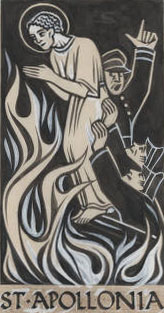
In honor of March being Women's History Month, here are a sample of Ade Bethune's drawings of women saints. There are more images available as part of St. Catherine University's Digital Collections.
Showing posts with label Ade Bethune. Show all posts
Saturday, March 17, 2012
Tuesday, December 13, 2011
"I Feel Like I've Seen Mecca"
Among her many interests, Ade Bethune was a proponent of the teachings of Maria Montessori. Bethune's St. Leo Shop became an outlet for Montessori's books, which were imported from India in the late 1950s and 1960s. In addition, Bethune sold her own booklets for writing instruction--"Teaching the Child to Write" (originally published in Jubilee magazine) and Uniscript: A New Method for Teaching Handwriting--which were based on Montessori's principles. The Ade Bethune Collection has copies of both of these, along with a set of plaster letters for children to trace with a finger.
I had been meaning to let the Montessori department at St. Kate's know the connection between Ade Bethune and Montessori's work, and had an opportunity to do Friday. One of their faculty members was visiting the Archives for another reason. I told her that Bethune had sold Montessori's books in her shop and we had those and other Montessori-related items in the Collection. After seeing the plaster letters and looking through the writing booklets, she told me she was speechless and wanted to come back later to spend more time looking through the materials. Her comment in the heading is how she described the experience to a colleague.
This encounter reminded me, yet again, how many hidden treasures are in the Ade Bethune Collection. Bethune herself was a complex and talented woman whose work and interests went far beyond her more commonly known tag of "Catholic Worker artist." There are gems to be explored by those involved in many fields, and it is my job to make them more widely known--to the St. Kate's community and beyond.
I had been meaning to let the Montessori department at St. Kate's know the connection between Ade Bethune and Montessori's work, and had an opportunity to do Friday. One of their faculty members was visiting the Archives for another reason. I told her that Bethune had sold Montessori's books in her shop and we had those and other Montessori-related items in the Collection. After seeing the plaster letters and looking through the writing booklets, she told me she was speechless and wanted to come back later to spend more time looking through the materials. Her comment in the heading is how she described the experience to a colleague.
This encounter reminded me, yet again, how many hidden treasures are in the Ade Bethune Collection. Bethune herself was a complex and talented woman whose work and interests went far beyond her more commonly known tag of "Catholic Worker artist." There are gems to be explored by those involved in many fields, and it is my job to make them more widely known--to the St. Kate's community and beyond.
Monday, November 14, 2011
45 Years of Community Activism
Another set of materials in the Ade Bethune Collection has been organized and is available for research. The Newport Community Organizations Materials document Bethune's involvement with the Point Association, East-West Point Committee, Citizens Advisory Committee, Foundation for Newport, and other groups in her adopted home of Newport, RI.
This part of the Collection covers almost a half-century of Ade Bethune's activities, from the late 1950s to her death in 2002. During this time, Bethune was active on the Board or in other leadership positions for many of these community groups. Her involvement with them centered on supporting Newport's citizens; she wanted to ensure they had good homes and neighborhoods. In this effort, Ade Bethune addressed multiple road and redevelopment issues--working for or opposing proposals based on the impact they would have on the community.
At a February, 1970 public hearing regarding a proposed highway that would bisect Ade Bethune's Point neighborhood, she prefaced her questions and comments with the following statement:
Organization of the Newport Community Organizations Materials and production of a finding aid for them was made possible by a CLIR "Cataloging Hidden Special Collections and Archives" grant with funding from The Andrew W. Mellon Foundation.
This part of the Collection covers almost a half-century of Ade Bethune's activities, from the late 1950s to her death in 2002. During this time, Bethune was active on the Board or in other leadership positions for many of these community groups. Her involvement with them centered on supporting Newport's citizens; she wanted to ensure they had good homes and neighborhoods. In this effort, Ade Bethune addressed multiple road and redevelopment issues--working for or opposing proposals based on the impact they would have on the community.
At a February, 1970 public hearing regarding a proposed highway that would bisect Ade Bethune's Point neighborhood, she prefaced her questions and comments with the following statement:
"I will speak in the name of families, and children, and mothers, of the elderly, of the poor people, of the pedestrians on both sides of the Point. People who have no advocate to plead their cause and defend their rights. . . People who are not here tonight because they are too young to be here, or too old, like my mother, people who are working tonight and can't come."Through her work, Ade Bethune made sure that everyone in the community would have a voice.
Organization of the Newport Community Organizations Materials and production of a finding aid for them was made possible by a CLIR "Cataloging Hidden Special Collections and Archives" grant with funding from The Andrew W. Mellon Foundation.
Tuesday, July 12, 2011
Summer Chautauqua Class
A class on Ade Bethune and her work will be part of St. Kate's first Summer Chautauqua next month. Running for 10 days (August 3-12), the Chautauqua will include 25 classes and events on a variety of topics.
Ade Bethune: Beyond the Catholic Worker will explore how Bethune's experiences with the Catholic Worker carried over into her work later on with many social justice concerns in her home of Newport, RI, including the Church Community Housing Corporation (CCHC), dedicated to safe and affordable housing for all, and Harbor House, a living community for elderly of mixed incomes. It will also look at how Bethune's emphasis on community played a role in her designs for Lumen Christi Church (including an optional "field trip" to the church, within walking distance of campus).
This class will be held Thursday, August 3rd, from 1-3pm. For more information, or to register, see the Summer Chautauqua web site.
Ade Bethune: Beyond the Catholic Worker will explore how Bethune's experiences with the Catholic Worker carried over into her work later on with many social justice concerns in her home of Newport, RI, including the Church Community Housing Corporation (CCHC), dedicated to safe and affordable housing for all, and Harbor House, a living community for elderly of mixed incomes. It will also look at how Bethune's emphasis on community played a role in her designs for Lumen Christi Church (including an optional "field trip" to the church, within walking distance of campus).
This class will be held Thursday, August 3rd, from 1-3pm. For more information, or to register, see the Summer Chautauqua web site.
![]() |
| Ade Bethune & CCHC president Edna Mae Nelson at the July, 1977 Open House for the first solar-powered house in Newport, RI. The house was designed by Bethune and built by CCHC. |
Labels:
Ade Bethune,
Catholic Worker,
churches,
events,
social justice
Friday, May 13, 2011
Getting Sucked in by Ade
This week a researcher visited the Collection. She's writing about an artist who was a close friend of Ade Bethune's from the National Academy of Design and Cooper Union. We have some correspondence between them, but she was also looking for more general information about Bethune. Since Ade Bethune was one of the major influences for the artist she is writing about, she wanted to get a sense of Bethune's thoughts on art.
I brought out the correspondence between Ade Bethune and Graham Carey, which begins in 1935 and runs through 1973—although there are fewer letters from the later years. Bethune and Carey had a prolific correspondence, discussing (among many other things) their views on art in general and Christian/Catholic art in particular. The researcher was impressed with the precociousness and maturity of ideas Bethune expressed, considering she was in her early 20s when they began writing each other. She remarked how it was difficult not to go slowly through the letters, reading every bit. She had to keep reminding herself she is not actually writing about Bethune.
An increasing fascination with Ade Bethune and her work is a common characteristic of visitors to the Collection. Most people who come find much more than they counted on, and more than a few get sidetracked down paths they didn't originally intend. The same happens when I give presentations on her and the Collection, as I did last week to a theology class. Several students expressed an interest in finding out more about her. The infectious power of Ade Bethune is strong, and draws people in to her art and life.
Monday, May 2, 2011
Saint Joseph the Worker
Saint Joseph the Worker (#3404) |
The appearance of Saint Joseph and her other drawings in The Catholic Worker helped launch Bethune's fame as an artist. Nearly all of Bethune's succeeding work can be traced to connections and ideas originating because of her involvement with the Catholic Worker movement. But St. Joseph the Worker carries additional significance to her work. In 1937 she published the treatise Work, an essay on the dignity of labor and the worship of God implied in a job done well. She later turned some of these same ideas into "The Person and the Industrial Counter-Revolution," a talk she gave at the College of St. Catherine (now St. Catherine University) in 1939 for the 3rd meeting of the Catholic Art Association. It was also the title of a 1940 article she published in the CAA's journal, Christian Social Art Quarterly.
With all these connections to the day and ideals of Saint Joseph the Worker, it is somehow fitting that Ade Bethune died on May 1, 2002.
Wednesday, April 27, 2011
Liberal Arts and the Love of Learning
Yesterday St. Catherine University initiated 19 new members into Phi Beta Kappa. It's one of the nice things about working here--being able to share a love of the liberal arts with other like-minded people who recognize the importance of lifelong learning. Among the values highlighted in St. Kate's Mission Statement is the integration of liberal arts and professional education. And this year the University is celebrating the Year of the Liberal Arts in conjunction with the last week's launch of the School of Humanities, Arts, and Sciences. How does all that relate to this blog and the Ade Bethune Collection? In this way: Ade Bethune was continually educating herself all throughout her life--when faced with something new, she would devote time to learning all she could about it.
Here are some examples:
- In the 1930s she taught art at Portsmouth Priory School (now Portsmouth Abbey School) in Portsmouth, Rhode Island. One year she was asked to teach mechanical drawing, a subject she knew nothing about. Using the class textbook, she taught herself, making sure to always stay one lesson ahead of the class. The knowledge of mechanical drawing she acquired proved beneficial later on, when she began working as a liturgical consultant. It allowed her to draft plans for church buildings, and to understand architectural drawings. The textbook she used is in the Ade Bethune Collection.
- While Ade Bethune had created art using a variety of media, she had not done much with metal until she began working with the Terra Sancta Guild in 1965. Terra Sancta, based in Philadelphia, partnered with a metal shop in Israel to produce and sell religious items cast in bronze. Bethune recognized that she needed a fuller understanding of the metal casting process in order to create appropriate designs. So she traveled to Israel in the summer of 1966 for that purpose. She met the men working in the shop, and learned from them, communicating through drawings and bits of Hebrew and German. Among other things, Bethune realized the process of sandcasting does not allow small details to be clearly visible, so her designs needed to incorporate simple shapes and lines. In the Ade Bethune Collection are multiple examples of work she did for Terra Sancta Guild, including a "Tree of Life" candleholder, the first piece she designed for them.
- As Bethune became more active as a liturgical consultant, the scope of work she performed broadened. In addition to providing artwork for churches she became involved with choosing church furnishings, lighting selection and placement, and making recommendations for the design and layout of church spaces. And it wasn't just the visuals--she paid attention to how music would sound in a church. She viewed singing as an important group activity, and it was necessary for the sound to fill the space, so everyone had a sense of the music they were singing together. Among the that Ade Bethune gave to St. Catherine University are one on acoustical engineering and another on music, acoustics and architecture. There is no way to know how much use she made of them, but it isn't difficult to imagine that the woman who taught herself mechanical drawing would also educate herself about how sound travels through space.
Thursday, January 27, 2011
Ade Bethune -- comic book artist
The Ade Bethune Collection has a Google alert running that sends an email whenever Google indexes a page that either 1) links to the Ade Bethune Collection web site or 2) contains Ade Bethune's name. This week's email included a post from the Women in Comics wiki. The post is primarily a listing of women who worked during the golden age of comics (1938-1955), and includes Ade Bethune's name. However, what is really interesting is the origin of the list--it is from the appendix of a book written by David Hajdu called The Ten-Cent Plague: The Great Comic-Book Scare and How It Changed America. The book describes the rise of comic books as a medium for popular culture, and the resulting backlash against them in the late 1940s-early 1950s by church groups, civic organizations, PTAs, and McCarthy-ites in the Senate, among others. The Appendix, in which Ade Bethune's name appears, is a list of "the artists, writers, and others who never again worked in comics after the purge of the 1950s."
Including Ade Bethune on this list of names associated with "purged" comic books seems to imply that she was producing the kind of content that religious groups and others objected to. In fact, Bethune's involvement with comics was as a contributor to Treasure Chest of Fun & Fact, published by George A. Pflaum from 1946 to 1972. Treasure Chest was begun as a response to the undesirable comic books of the time. It was distributed to Catholic parochial schools throughout the U.S. and was meant to emphasize morality, faith, family, and citizenship. Treasure Chest contained primarily non-fiction stories about sports and folk heroes, saints, and other uplifting figures.
Ade Bethune drew a number of covers for Treasure Chest. Her first was for the April 5, 1949 issue and her last was for June 7, 1962. Other of Bethune's more than 20 front and back covers include those in April 1952, January 1954, February 1955, and March 1958. She also contributed stories to the comic book, including the series Jesus Spoke in Parables from 1951-1952. Bethune also contributed to another of Pflaum's publications, Our Little Messenger.
Sketches for some of Ade Bethune's Treasure Chest covers and drawings for Our Little Messenger are in the Ade Bethune Collection. More examples of and information about her work for children are in the exhibition "Seeing Things Through a Child's Eyes."
![]() |
| One of Bethune's Treasure Chest covers |
Ade Bethune drew a number of covers for Treasure Chest. Her first was for the April 5, 1949 issue and her last was for June 7, 1962. Other of Bethune's more than 20 front and back covers include those in April 1952, January 1954, February 1955, and March 1958. She also contributed stories to the comic book, including the series Jesus Spoke in Parables from 1951-1952. Bethune also contributed to another of Pflaum's publications, Our Little Messenger.
Sketches for some of Ade Bethune's Treasure Chest covers and drawings for Our Little Messenger are in the Ade Bethune Collection. More examples of and information about her work for children are in the exhibition "Seeing Things Through a Child's Eyes."
Tuesday, June 8, 2010
The Ade Bethune Collection
St. Catherine University’s Ade Bethune Collection (ABC) contains the papers of Ade Bethune, a world-renowned liturgical artist and social activist. Ade Bethune made unique contributions to the field of sacred art and architecture as an artist, writer, and liturgical consultant, all flowing from her early association with Dorothy Day and the publication of her pictures in The Catholic Worker. Her career spanned over 70 years from art school in New York in the 1930s to her final projects in the early years of the 21st century. In Ade Bethune, St. Catherine University finds an apt symbol of its own mission and daily work—to educate women to lead and influence within the Catholic traditions of intellectual inquiry and social justice.The extensive holdings of the ABC cover Bethune's entire career. They consist of manuscript and printed materials, as well as a large variety of non-textual materials (graphic, sound, artifact). There are approximately 400 linear feet of papers, books, periodicals, drawings, photographs, slides, films, and audio/video tapes. In addition, there are about 170 cubic feet of oversized drawings, architectural plans, models, paintings, textiles, and artifacts. The Collection contains examples of Bethune's work in many media: ink on paper, tempera, silkscreen, bronze, pewter, wood, textile, clay, and stained glass.
Subscribe to:
Posts (Atom)


